VIOFO T330 vs T340: Which 3-Channel Cam to Buy?
VIOFO T330 vs T340: same 4K front, 2K rear and 9.0 score, but the cabin camera, HDR and a fourth-camera option split them. Here's which one to buy.
Disclosure: Dashlore earns a commission on purchases made through some links on this page, at no added cost to you. Scores come from the spec rubric, never from commission rates. Details
On this page
Key takeaways
- Both score 9.0 and share a 4K STARVIS 2 IMX678 front camera, a 2K STARVIS 2 IMX675 rear camera, Wi-Fi 6, GPS, voice control and five parking modes.
- The T330's 210° cabin camera is a separate module on a 1 m cable with a Sony STARVIS 2 IMX675 sensor; the T340's is built into the front unit on an OmniVision OS04J10.
- The T330 runs HDR on all three channels; the T340 runs HDR on the front plus only one of the cabin or rear cameras.
- The T340 can grow to four channels with an optional telephoto or second rear camera; the T330 tops out at three.
- Pick the T330 for the best cabin footage and an adjustable cabin view; pick the T340 for a single housing, the simplest install and room for a fourth camera.
Buy the VIOFO T330 if cabin footage matters most, and the T340 if you want the simplest install or a fourth camera later. Both score 9.0 and share the same 4K front and 2K rear cameras. The difference is the cabin camera: the T330 uses a separate STARVIS 2 module with HDR on every channel, while the T340 builds an OmniVision sensor into the front unit.
| Spec | 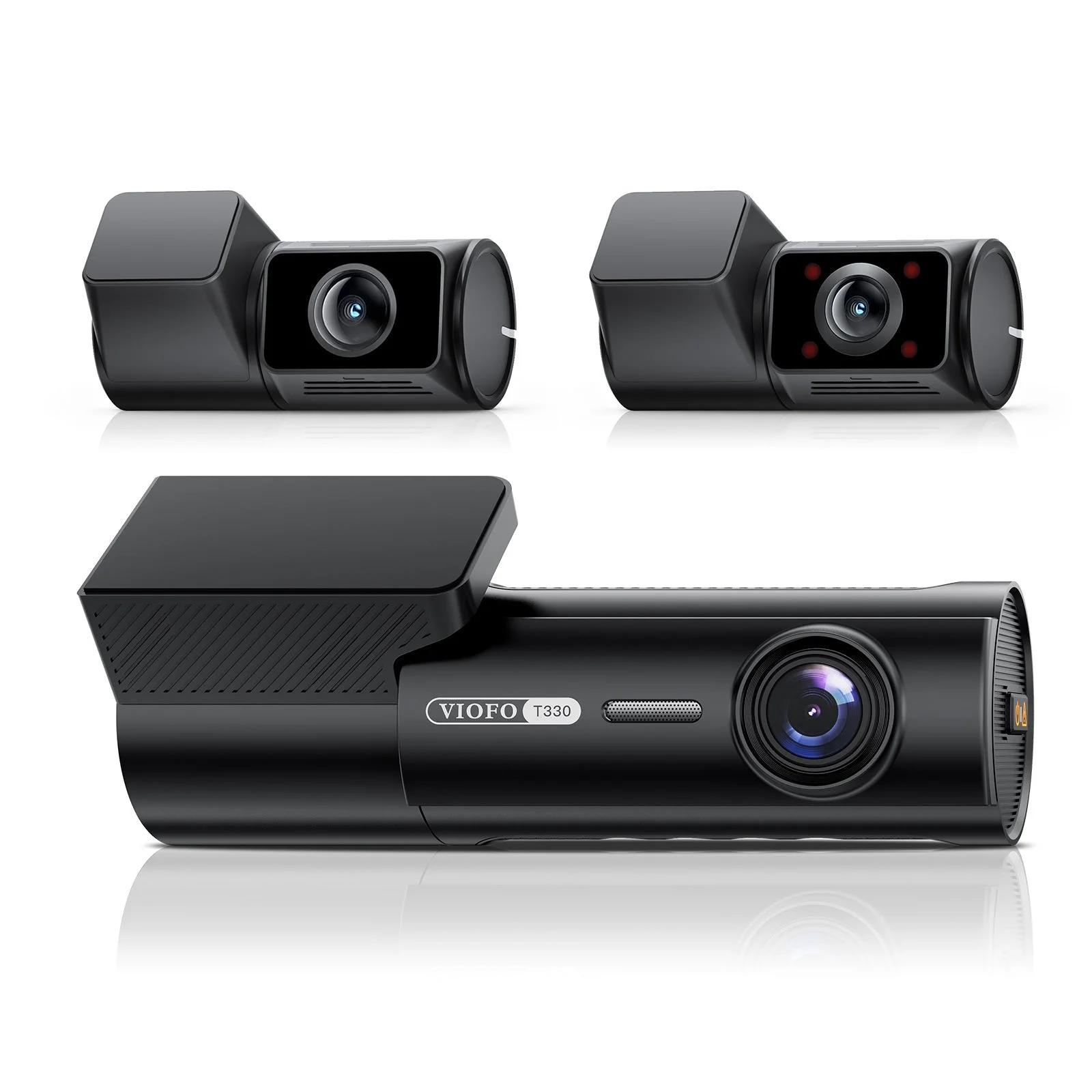 | 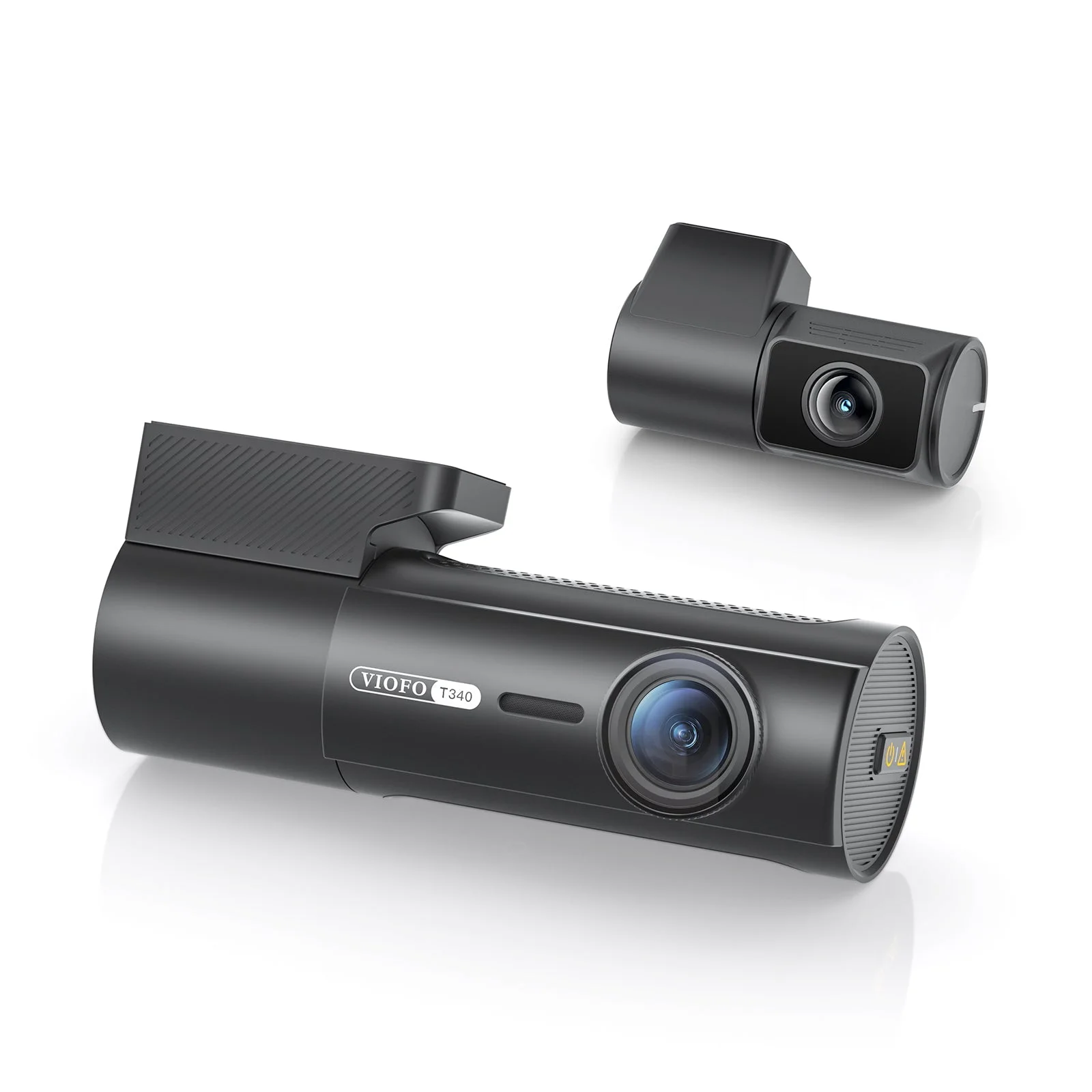 |
|---|---|---|
| Score | 9.0 | 9.0 |
| Front resolution | 2,160 px | 2,160 px |
| Front frame rate | 30 fps | 30 fps |
| STARVIS 2 sensor | Yes | Yes |
| HDR | Yes | Yes |
| Coverage (channels) | 3 | 3 |
| Rear resolution | 1,440 px | 1,440 px |
| Cabin resolution | 1,440 px | 1,440 px |
| Cabin infrared | Yes | Yes |
| Buffered parking mode | Yes | Yes |
| Low-bitrate parking | Yes | Yes |
| Heat tolerance (power cell) | supercapacitor | supercapacitor |
| GPS | built-in | built-in |
| Wi-Fi transfer | 5GHz | 5GHz |
| Max storage | 512 GB | 512 GB |
| LTE / cloud | No | No |
| Front pixels per degree | 27.43 px/° | 27.43 px/° |
| Rear STARVIS 2 sensor | Yes | Yes |
| Time-lapse parking | Yes | Yes |
| Max operating temperature | 65°C | 65°C |
| Price | $499.99 at VIOFO, Nov 20 | $539.99 at VIOFO, Nov 20 |
| Where to buy | Check price on Amazon | Check price on Amazon |
The table looks identical, and on our dash cam rubric so are the scores. Both earn full marks on front resolution, STARVIS 2, HDR, three-channel coverage, a 1440p infrared cabin camera, buffered and low-bitrate parking, supercapacitor power, GPS and 5GHz Wi-Fi, and both take microSD cards up to 512GB. Both give up a little for 30fps at 4K, a 2K rather than 4K rear camera and no built-in LTE. At 9.0 they tie with the A329S 3CH for second among the 45 dash cams we track, behind only the A229 Ultra 3CH (9.2), in our dash cam rankings. Their Rideshare scores tie too, at 9.0, the top of that profile.
So the decision comes down to the cabin camera, HDR and expansion. VIOFO’s own spec tables for the T330 and T340 spell them out.
What is the difference between the VIOFO T330 and T340?
Here’s every published difference in one place:
| Spec | VIOFO T330 3CH | VIOFO T340 3CH |
|---|---|---|
| Cabin camera design | Separate fisheye module, 1 m cable | Built into front unit |
| Cabin sensor | Sony STARVIS 2 IMX675 (5MP) | OmniVision OS04J10 (4MP) |
| Cabin resolution and view | 2K, 210°, F2.2 | 2K, 210°, F2.2 |
| Cabin night vision | IR LEDs (count not published) | Four IR LEDs |
| HDR | Front, rear and cabin | Front plus one of cabin or rear |
| Maximum channels | 3 | 4 (optional telephoto or second waterproof rear) |
| Front camera | 4K, STARVIS 2 IMX678, 140°, F1.8 | Same |
| Rear camera | 2K, STARVIS 2 IMX675, 160°, F1.8 | Same |
| Parking hardwire kit | HK6-F (sold separately) | HK6-F (sold separately) |
Everything else is shared: Wi-Fi 6 on 2.4GHz and 5GHz, built-in GPS, voice control, no screen, supercapacitor power and five parking modes including hybrid, buffered, time-lapse and low bitrate. VIOFO publishes the same -20°C to 65°C operating range for both, and both accept microSD cards up to 512 GB. On the thermal side, DashCamTalk tester rcg530 used a thermal camera on the T330 and found it runs significantly cooler than a Vantrue E1 Pro, which hit 149°F near the card slot after a 30-minute drive; no thermal shutdowns were reported through months of testing.
Do they use the same sensors?
Front and rear, yes. Both pair an 8MP Sony STARVIS 2 IMX678 at 4K up front with a STARVIS 2 IMX675 at 2K out back. DashCamTalk tester rcg530 compared T330 front footage against the A329S and found the same IMX678 sensor delivers comparable results. Aussiecams reports plates are clearly readable on both front and rear cameras after nearly a month of driving. Road footage from the two models should start from the same hardware.
The cabin camera is where they split, and it’s a meaningful split. The T330’s cabin module uses the same STARVIS 2 IMX675 as the rear camera. STARVIS 2 is Sony’s low-light-focused sensor line, and a cabin camera spends much of its life in the dark. The T340 uses an OmniVision OS04J10, a 4MP sensor, and leans on its four IR LEDs to light the cabin at night.
Both record the cabin at 2K through a 210° lens, so resolution and coverage match. Our STARVIS 2 explainer covers what that sensor line adds. What you can’t read off a spec sheet is how the two sensors compare in practice; neither VIOFO nor anyone else publishes comparable low-light figures. Aussiecams demonstrates the T330’s 210° fisheye interior camera captures not just the cabin but also the sides of the vehicle, making it well-suited for rideshare drivers who need wall-to-wall coverage.
How does HDR compare?
This is the second real difference. The T330 lists HDR on all three channels, and its owner’s manual confirms “you can set HDR for all cameras separately.” The T340’s spec table reads “Front HDR + one of Interior / Rear HDR,” and its owner’s manual spells out the limit: “In recording mode, HDR can only be enabled for the front camera and one additional channel among the rear, cabin, or exterior cameras.” You choose which of the other cameras gets it.
Why it matters: HDR keeps bright and dark areas readable in the same frame, and our HDR vs WDR explainer covers the difference in depth. At night, the rear camera faces the headlights of the car behind you, and the cabin camera faces bright windows with a dark interior. Both are classic HDR cases. Vortex Radar calls the T330’s all-channel HDR a significant upgrade over VIOFO’s older models that only used WDR and struggled to capture plates at night; Aussiecams sets HDR to auto with a timer schedule via the app. With the T340, you have to pick one. Rideshare drivers would usually give it to the cabin; anyone worried about rear-end collisions might give it to the rear.
How do parking modes compare?
They’re the same. Both list five parking modes, including buffered auto event detection, time-lapse, low-bitrate and a hybrid mode, and both need VIOFO’s HK6-F hardwire kit, sold separately, for any of them. VIOFO describes the HK6-F as the dedicated kit for the T330 and T340 series. Our hardwire install guide walks through the fuse-tap process, and our parking mode setup guide covers configuration.
Buffered parking is one of the heaviest-weighted features in our rubric because it saves the seconds before a parking-lot impact, not just the aftermath. Both cams get it. If you’re new to the settings, our G-sensor guide explains how to tune impact sensitivity for driving and parking.
One caveat from field testing: rcg530 on DashCamTalk measured the T330’s low-power impact-detection (LPID) mode drawing 24–26 mA through the HK4 hardwire kit at 12.6 V, well above VIOFO’s published 1 mA claim. That won’t matter on a healthy battery overnight, but it’s worth noting if you plan multi-day parking. Vortex Radar reports VIOFO estimates 9–15 hours of parking recording on the optional BP60 battery pack with the T330 3CH, depending on the mode. Our battery drain guide covers safe voltage cutoff settings.
Can you add a fourth camera?
Only to the T340. Because its cabin camera is built into the front unit, the T340 keeps a port free for another camera, and VIOFO’s T340 manual lists four-channel combinations: front, cabin and rear plus a telephoto camera, or front, cabin and two waterproof rear cameras. VIOFO sells the telephoto version as the T340 4CH. A telephoto lens narrows the view to pick out plates further ahead, and a second waterproof rear camera suits vans and trailers.
The T330’s manual stops at three channels. Its front unit has two camera ports, and the separate cabin module takes one of them, so cabin plus rear fills it; a telephoto or waterproof camera would have to replace one of those. If you think you’ll want a fourth view, that settles it for the T340.
Which is easier to hide?
It depends on what “hide” means for you.
The T340 is the cleaner install. One housing on the glass holds both the road camera and the cabin camera, plus a single cable to the rear camera. VIOFO lists the front unit at 5.35 x 2.23 x 2.17 inches. Fewer parts means fewer adhesive pads, fewer cables to tuck into the headliner, and nothing extra in the cabin for passengers to notice.
The T330 is more flexible. Its cabin camera is a separate module on a 1 m cable that plugs into the front unit’s secondary camera port. You can aim it independently of the road camera, or mount it slightly away from the main unit for a better angle on the back seat. Multiple reviewers praise the barrel form factor for discretion: Aussiecams calls it their favorite VIOFO release to date specifically because barrel-style cams integrate seamlessly behind the rearview mirror. PANZER DASHCAM notes the T330 ships with a tamper-resistant cover secured by hex screws that blocks casual access to cables and the SD card slot.
Both are screenless, which helps discretion: no glowing display, and setup and playback happen in the VIOFO app. Our where to mount a dash cam guide covers ideal windshield positioning, the hidden dash cam roundup lists other low-profile options, and truckers should see our truck driver dash cam picks for the FMCSA mounting zone.
Which should you buy?
Buy the VIOFO T330 3CH if the cabin camera is the reason you’re buying a 3-channel cam. It has the stronger cabin hardware on paper (a STARVIS 2 sensor rather than OmniVision), HDR on every channel, and a cabin view you can aim on its own. That’s the better fit for rideshare and taxi drivers, whose cabin footage is the evidence most likely to be needed; check our guide to dash cam audio recording laws and Uber and Lyft dash cam rules before you record passengers. Tesla owners weighing it against the car’s own cameras should see Tesla Sentry Mode vs a dash cam.
Better cabin camera
VIOFO T330 3CH
- Front resolution
- 2,160 px
- Coverage (channels)
- 3
- STARVIS 2 sensor
- Yes
- Buffered parking mode
- Yes
A screenless three-channel dash cam with 4K front, 2K rear and a 2K 210° fisheye cabin camera with IR LEDs, all with HDR. It suits rideshare drivers who want a discreet camera managed from the app.
Strengths
- 4K front, 2K rear and 2K interior at 30fps on STARVIS 2 sensors
- Separate 210° fisheye cabin module on a STARVIS 2 IMX675 with IR LEDs; HDR on all three channels
- Wi-Fi 6 on 2.4GHz and 5GHz, built-in GPS and voice control
- Five parking modes including hybrid, buffered, time-lapse and low bitrate
Watch out for
- No display; setup and playback are done through the app
- Parking mode needs the optional HK6-F hardwire kit
Buy the VIOFO T340 3CH if you want the simplest, tidiest install with the fewest parts, and you’re happy to choose whether the cabin or rear camera gets HDR. Its built-in cabin camera with four IR LEDs still covers the whole cabin at 2K, and it’s the only one of the two that can add a fourth camera later.
Simpler all-in-one install
VIOFO T340 3CH
- Front resolution
- 2,160 px
- Coverage (channels)
- 3
- STARVIS 2 sensor
- Yes
- Buffered parking mode
- Yes
A screenless three-channel dash cam with a 4K front camera, a 2K rear camera and a built-in 2K infrared cabin camera with a 210° view. It suits rideshare drivers who want an all-in-one front and cabin unit.
Strengths
- 4K front on a STARVIS 2 IMX678, 2K rear on a STARVIS 2 IMX675, 2K interior, all at 30fps
- Built-in IR interior camera with a 210° field of view
- Wi-Fi 6 on 2.4GHz and 5GHz, built-in GPS and voice control
- Five parking modes including hybrid, buffered, time-lapse and low bitrate
Watch out for
- HDR on the front plus only one of the interior or rear cameras
- Interior camera uses an OmniVision OS04J10 sensor
- No display; parking needs the optional HK6-F hardwire kit
Either way, you’re getting a cam tied for the second-highest score we give. For more VIOFO options, see our best VIOFO dash cam ranking. For more 3-channel options with screens, see our best 3-channel dash cam roundup, rideshare dash cam picks and rideshare install guide, or filter every model by channel count in the dash cam finder. Full spec sheets: T330 3CH and T340 3CH.
What reviewers found on video
YouTube videos about the VIOFO T330 3CH and VIOFO T340 3CH that our research draws on. Each video is the creator's own work, and it loads from YouTube only when you press play.
VIOFO T330 3CH

VIOFO T340 3CH

Frequently asked questions
What is the difference between the VIOFO T330 and T340?
The cabin camera. The T330 uses a separate 210° fisheye cabin module with a Sony STARVIS 2 sensor and HDR on all channels. The T340 builds a 210° infrared cabin camera into the front unit, uses an OmniVision sensor, and limits HDR to the front plus one other channel.
Do the T330 and T340 use the same sensors?
Front and rear, yes: a 4K Sony STARVIS 2 IMX678 front and a 2K STARVIS 2 IMX675 rear. The cabin sensors differ: STARVIS 2 IMX675 on the T330, OmniVision OS04J10 on the T340.
Which is better for rideshare, the T330 or T340?
The T330 on paper, because its cabin camera has a STARVIS 2 sensor and HDR, and you can aim it separately. The T340 is simpler to install with fewer parts on the glass.
Do the T330 and T340 need a hardwire kit?
For parking mode, yes. VIOFO says both need the optional HK6-F hardwire kit, which it describes as the dedicated kit for the T330 and T340 series.
Can you add a fourth camera to the T330 or T340?
Only the T340. VIOFO's T340 manual lists four-channel setups that add a telephoto or second waterproof rear camera. The T330's manual stops at three channels, because its separate cabin module takes one of the front unit's two camera ports.
Does the VIOFO T330 run hot?
DashCamTalk tester rcg530 used thermal imaging and found the T330 runs significantly cooler than a Vantrue E1 Pro, which hit 149°F near the card slot. No thermal shutdowns were reported through months of testing.
Related reading
Best ofDash Cams
Best Dash Cam for Tesla: Model 3 and Model Y Picks
The VIOFO T330 3CH is the best dash cam for a Tesla Model 3 or Model Y. We rank screenless cams with 1440p-plus rear cameras vs Sentry Mode.
Best ofDash Cams
Best Dash Cam for Truck Drivers: 4K Picks for Semis
The best dash cams for truck drivers: 4K cams with cabin cameras ranked for plate detail, plus the FMCSA windshield-mounting rule and crash-review video.
Best ofDash Cams
Best VIOFO Dash Cam: Every Model Ranked
The best VIOFO dash cam is the A229 Ultra 3CH. We rank every VIOFO model we track on one rubric and decode the A229, A329S, T-series and Mini lines.
Best ofDash Cams
Best Dash Cam for Rideshare: Uber and Lyft Picks Ranked
The best dash cam for rideshare is the VIOFO A229 Ultra 3CH, ranked #1 among every cam we track with a 1080p-plus cabin camera. Full rankings.