Radar Detector Laws in California: Mounting Rules Explained
Radar detectors are legal in California cars, but Vehicle Code 26708 limits what goes on the windshield and jammers are banned. Here's where to mount one.
Disclosure: Dashlore earns a commission on purchases made through some links on this page, at no added cost to you. Scores come from the spec rubric, never from commission rates. Details
On this page
Key takeaways
- Radar detectors are legal in California passenger vehicles; they're banned in commercial vehicles over 10,000 lbs, on military bases and on federal property.
- Vehicle Code § 26708 bars objects on the windshield except in listed zones: a 7-inch square in the lower passenger-side corner and a 5-inch square in the lower driver-side corner.
- Radar detectors aren't named in any § 26708 exception, so a dash, visor or mirror mount is the lowest-risk option.
- Laser and radar jammers are illegal under Vehicle Code § 28150: an infraction, or a misdemeanor for four or more devices.
- For California's red-light and AB 645 speed cameras, GPS camera alerts matter more than radar sensitivity.
Yes, radar detectors are legal in California passenger vehicles — no state law bans owning or using one. The catch is mounting: Vehicle Code § 26708 bars objects on the windshield outside a few listed zones, and radar detectors aren’t among the exceptions. Mount on the dash, visor or mirror, and never install a jammer.
| State | Passenger vehicles | Commercial (10,001+ lbs) | Details |
|---|---|---|---|
| California | legal | illegal | No state law restricts radar detectors in passenger vehicles, but California Vehicle Code § 26708 bars objects on the windshield except in limited areas such as a 7-inch square in the lower passenger-side corner and a 5-inch square in the lower driver-side corner, and commercial vehicles over 10,000 lbs are covered by the federal ban. Source |
That row comes from our radar detector laws by state table, which tracks all 50 states and D.C. with a source link for each. Below, we break down exactly what § 26708 allows, what it doesn’t, and what that means for where your detector goes.
Are radar detectors legal in California?
In a passenger car, yes. California has no statute restricting radar detectors, so you can buy, own and use one. Nationally, only Virginia and Washington D.C. ban them in passenger vehicles — our are radar detectors legal? explainer covers every state, and our Virginia radar detector laws post explains the only full state ban.
Several groups of California drivers can’t use one:
- Commercial drivers. The federal ban (49 CFR § 392.71) covers commercial motor vehicles over 10,000 lbs. Federal rules bar operating a commercial motor vehicle that even contains a detector, powered on or not. Because the rule targets the vehicle classification, rideshare and taxi drivers operating under a commercial authority should verify whether their situation triggers the federal ban — the 10,000-lb threshold doesn’t apply to every part of the regulation.
- Anyone on a military base or federal property. Radar detectors are prohibited on military installations and other federal property regardless of state law.
- Anyone using a jammer. That’s a separate law, covered below.
Where can you mount a detector under VC 26708?
California Vehicle Code § 26708 starts with a blanket rule: you can’t drive with any object or material placed, displayed, installed, affixed or applied to the windshield or side or rear windows. Then it lists exceptions:
| Zone | Size | Who the statute allows there |
|---|---|---|
| Lower corner farthest from the driver (passenger side) | 7-inch square | Signs, stickers or other materials; portable GPS; video event recorders |
| Lower corner nearest the driver | 5-inch square | Signs, stickers or other materials; portable GPS (outside any airbag zone); video event recorders |
| Uppermost center of the windshield | 5-inch square | Toll and CHP communication devices; video event recorders |
Portable GPS units and video event recorders (dash cams) are named. Radar detectors aren’t. The two lower-corner squares also cover “signs, stickers, or other materials,” and whether a detector counts as “other materials” is a question the statute doesn’t answer.
Here’s how we read the options, from lowest to highest risk:
- Off the glass entirely. A sticky dash mount, a visor clip or a rearview-mirror mount keeps the detector off the windshield, so § 26708(a)(1) doesn’t apply. Make sure it doesn’t block your view, because § 26708(a)(2) separately bars anything that obstructs or reduces your clear view through the windshield. Our guide to how to mount a radar detector compares mount types.
- Inside a lower-corner square. A small detector entirely within the 7-inch passenger-side or 5-inch driver-side square stays in a zone the statute allows for other items. It’s the most defensible windshield spot, but not an explicit safe harbor.
- High and centered on the glass. This is where most suction-cup mounts end up, and where detectors see best. It’s also outside every zone § 26708 allows for anything but toll tags and dash cams.
A detector mounted low in a corner may have part of its view blocked by the hood or dashboard. A dash mount near the base of the windshield keeps a clear line of sight forward while staying off the glass. The same § 26708 rules apply to dash cam windshield placement — California is one of the stricter states.
Can you get a ticket for windshield placement?
Yes, in principle. A § 26708 windshield-obstruction citation doesn’t depend on what the object is. An officer who sees a detector suction-cupped in the middle of your windshield can cite the placement, even though the detector itself is legal.
How often that happens isn’t published, and we won’t guess. But the fix is free: move the detector off the glass and the question goes away. Arizona uses the same 7-inch and 5-inch corner squares, and Nevada allows a 6-inch square in the lower corner farthest from the driver:
| State | Passenger vehicles | Commercial (10,001+ lbs) | Details |
|---|---|---|---|
| Arizona | legal | illegal | No state law restricts radar detectors in passenger vehicles, but A.R.S. § 28-959.01 bars objects on the windshield that obstruct the driver's view except in a 7-inch square in the lower passenger-side corner or a 5-inch square in the lower driver-side corner, and commercial vehicles over 10,000 lbs are covered by the federal ban. Source |
| Nevada | legal | illegal | No state law restricts radar detectors in passenger vehicles, but NRS § 484D.435 bars nontransparent material on the windshield that obstructs the view except within a 6-inch square in the lower corner farthest from the driver, and commercial vehicles over 10,000 lbs are covered by the federal ban. Source |
| Oregon | legal | illegal | No state law restricts radar detectors in passenger vehicles, but ORS § 815.220 bars any material on the front windshield that prevents or impairs seeing into or out of the vehicle, and commercial vehicles over 10,000 lbs are covered by the federal ban. Source |
Are laser jammers legal in California?
No. Vehicle Code § 28150 bars equipping a vehicle with a jamming device, and bars anyone from using, buying, possessing, manufacturing or selling one. It covers devices that jam, scramble, neutralize or disable radar, laser or any other electronic device police use to measure speed.
A violation is an infraction. Possessing four or more devices is a misdemeanor.
This matters if you’re shopping at the top of the market. Installed systems such as the Escort Redline Ci 360c ship with integrated laser shifters, and Uniden’s R9w includes software-configurable laser heads that Vortex Radar’s 2024 Seattle group test ranked as the best-performing laser jammer system tested. Because § 28150 bans a vehicle being “equipped” with a jammer — not just using one — installing either system’s laser-jamming hardware in a California car is off-limits.
A radar detector only listens. It’s legal. A jammer transmits. It isn’t.
Can police detect your radar detector in California?
Some agencies use radar-detector detectors (RDDs) such as the Spectre III. In California the question is academic: detectors are legal, so RDD stealth adds no legal benefit. It matters in Virginia, where detectors are banned.
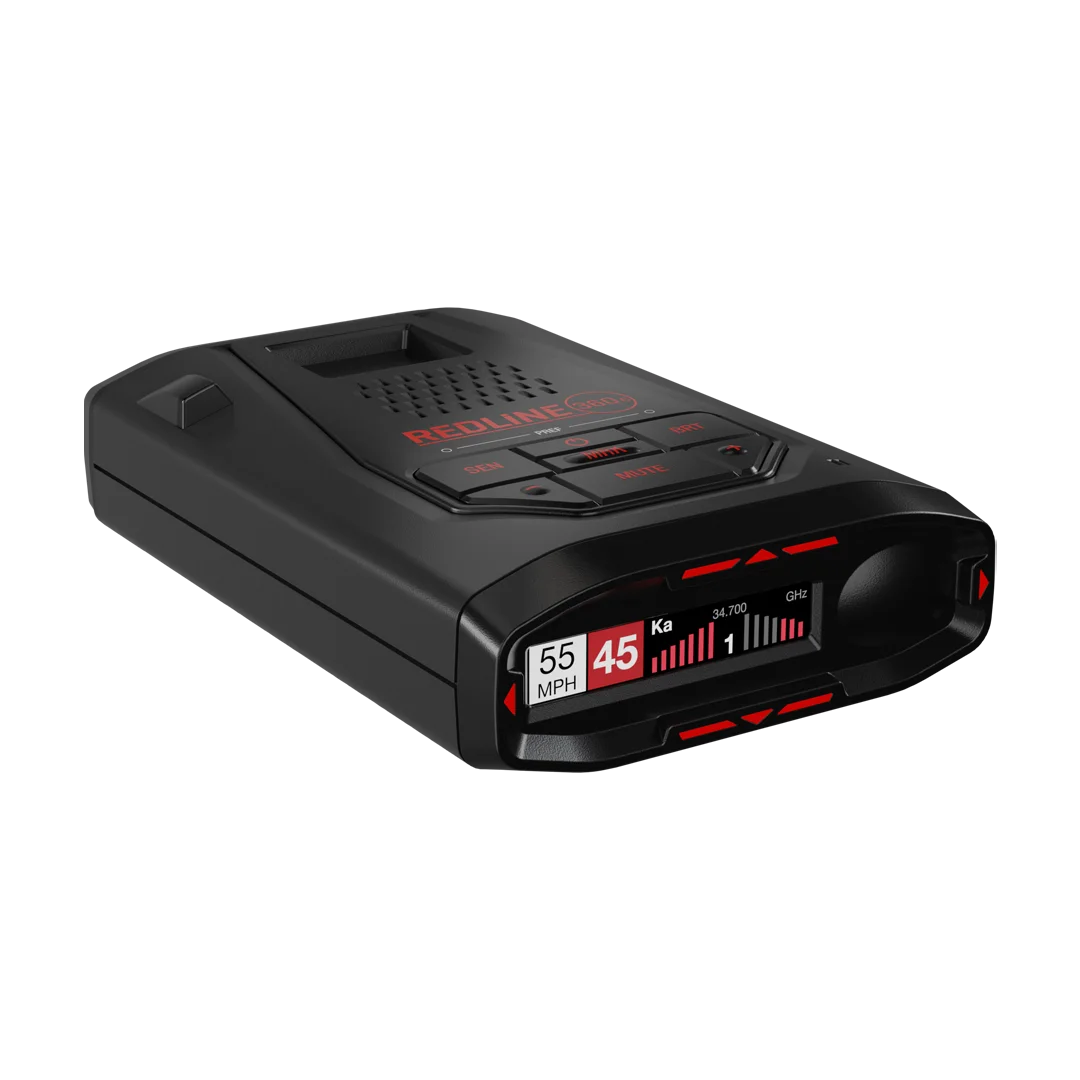
POC Network and TechGearLab verified that the Escort Redline 360c is completely undetectable by the Spectre III, thanks to extra internal shielding. The Uniden R8w and R8 claim stealth against the older Spectre I and IV — their manuals list those models — but neither has been independently verified against the Spectre III that the Redline 360c was tested with. TechGearLab lists the R8’s incomplete RDD stealth as a drawback. The Escort MAX 360c MKII makes no stealth claim.
Which detectors suit California photo enforcement?
California’s automated enforcement is mostly cameras. Red-light cameras don’t transmit anything a detector can hear, and AB 645 speed cameras are fixed-location — San Francisco runs them at 33 sites, issuing citations starting at 11–15 mph over the limit according to the SFMTA. Both favor a GPS camera database over raw detection. 24KTested confirmed that GPS camera alerts on the Uniden R8w triggered reliably at fixed sites, calling the feature alone worth the price of the detector.
Prioritize a camera database with easy updates, GPS lockouts to quiet urban K-band clutter and MultaRadar detection for low-power photo radar wherever you travel. By those criteria, three detectors in our radar detector rankings stand out for California:
- Escort Redline 360c (Dashlore Score 9.6): TechGearLab awarded it a perfect 10/10 for range. Auto lockouts, MRCD detection and 2.4 GHz Wi-Fi are built in. Ka response time is sluggish at factory defaults (~0.46 s on wide Ka), but RDForum testers measured it dropping to roughly 0.21 s when Ka is segmented to three segments. Escort’s Defender red-light and speed camera database requires a paid subscription. TechGearLab also found Ford trucks can trigger false MRCD alerts.
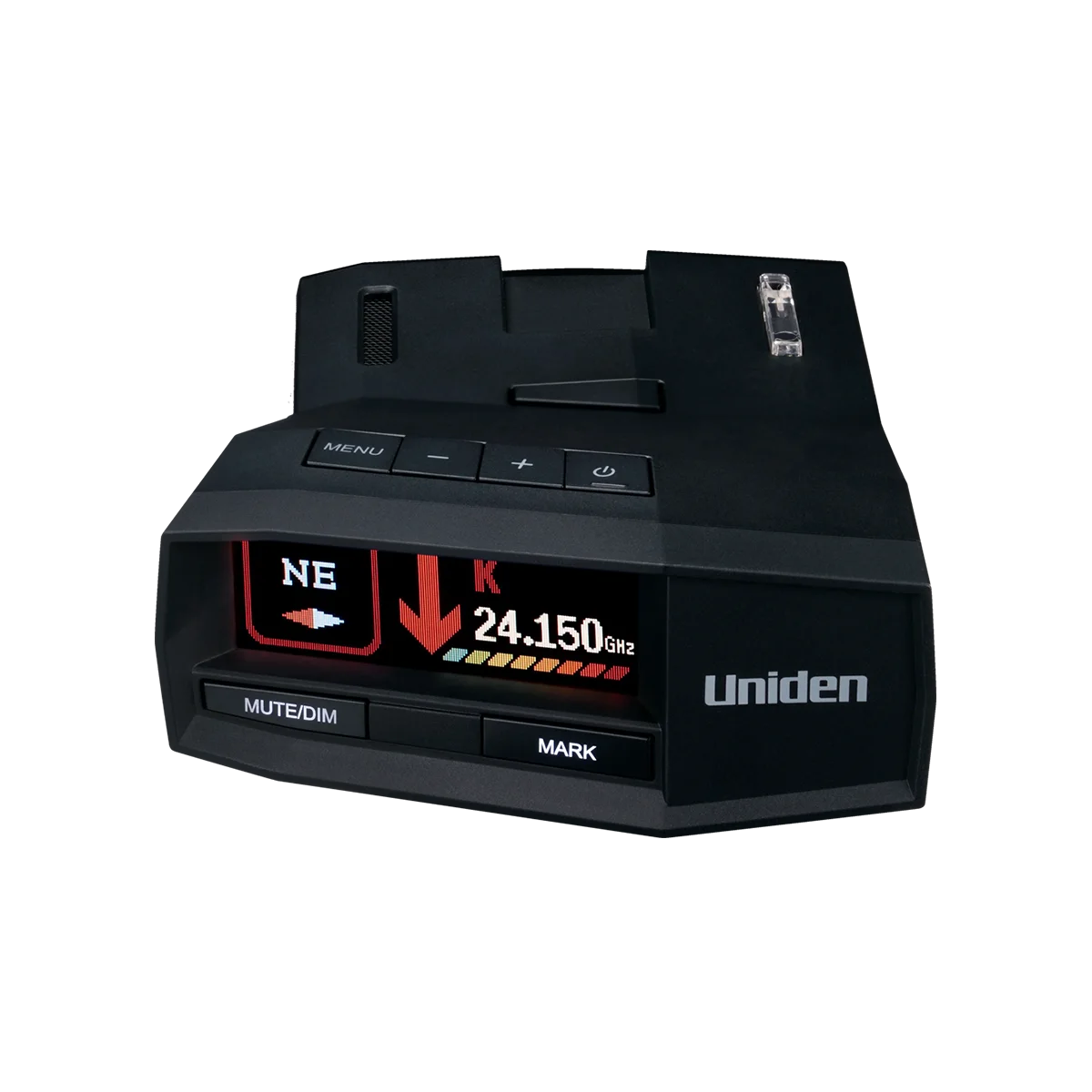
- Uniden R8w (9.6) or R8 (9.4): camera alerts with no subscription, MultaRadar detection and auto lockouts. Road & Track’s 2025 group test named the R8w the longest-range detector in the group. The R8w adds Wi-Fi for wireless updates, though Vortex Radar and owners report the update experience can be problematic — Bluetooth failures and display blackouts after app updates sometimes require USB fallback. Our Uniden R8 vs R8w comparison covers the trade-off.
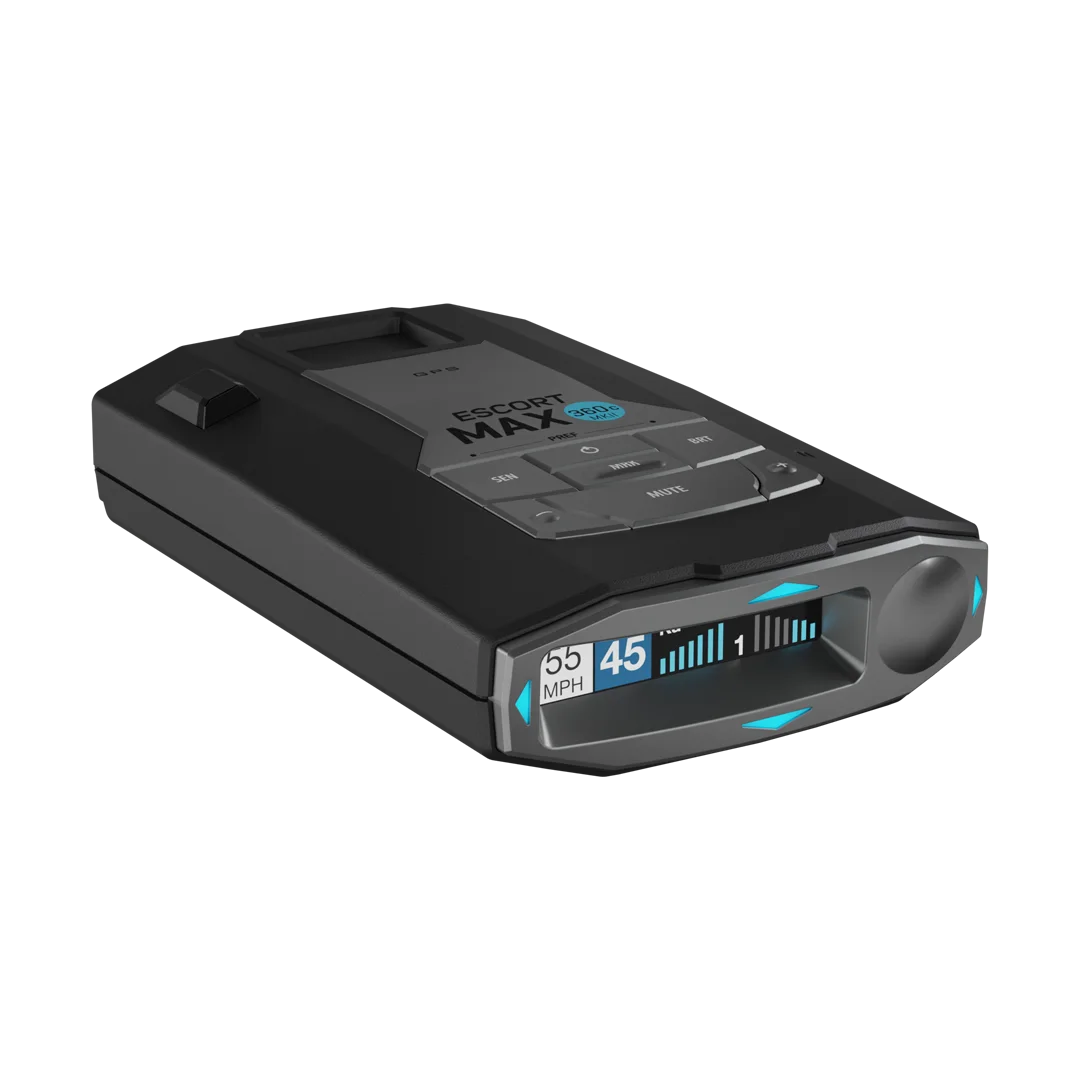
- Escort MAX 360c MKII (9.0): dual-band Wi-Fi and the Drive Smarter app for crowd-sourced alerts. Vortex Radar calls it one of the quietest daily drivers for BSM filtering, but also measured 2–4-second delays on K-band instant-on — a trade-off for highway drivers who encounter brief enforcement signals. Owners report the 5 GHz Wi-Fi can be flaky. Escort’s Defender camera database requires a paid subscription. Our Escort MAX 360c MKII vs Uniden R8 comparison breaks down the choice.
Mount whichever you choose off the glass, turn on MultaRadar detection if it ships disabled, and keep the camera database current. Our radar detector vs Waze comparison covers what a phone app adds alongside a detector.
How we compiled this
Our state table records whether detectors are legal in passenger and commercial vehicles, with a note and a primary-source link for every jurisdiction. For California, we read § 26708 and § 28150 in full and summarized only what the text says; we didn’t infer enforcement practice. This isn’t legal advice, and statutes change, so check the source link in the table before relying on it.
Planning a trip? Use the interactive lookup on the radar detector laws page for every state on your route.
Frequently asked questions
Are radar detectors legal in California?
Yes, in passenger vehicles. No California law bans them, but commercial vehicles over 10,000 lbs fall under the federal ban, detectors are prohibited on military bases and federal property, and Vehicle Code § 26708 limits what you can attach to the windshield.
Can I mount a radar detector on my windshield in California?
Vehicle Code § 26708 bars objects on the windshield outside listed zones, such as a 7-inch square in the lower passenger-side corner, and radar detectors aren't named in its exceptions. A dash, visor or mirror mount avoids the question.
Are laser jammers legal in California?
No. Vehicle Code § 28150 bans equipping a vehicle with, or using, buying, possessing or selling, a device that jams or interferes with police radar or laser speed measurement.
Do radar detectors work against California speed cameras?
Don't count on radar alone. AB 645 speed cameras are fixed-location, so GPS camera alerts from a detector's database warn you at known sites whatever technology the camera uses.
What's the penalty for a radar jammer in California?
A § 28150 violation is an infraction. Possessing four or more jamming devices is a misdemeanor.
Can police detect that I have a radar detector?
Some agencies use radar-detector detectors (RDDs) like the Spectre III. The Escort Redline 360c is verified undetectable by the Spectre III. The Uniden R8w and R8 claim stealth against the older Spectre I and IV, but neither has been independently tested against the Spectre III.
Related reading
GuideRadar Detectors
Can Police Detect Radar Detectors? RDDs Explained
Can police detect radar detectors? Yes, with RDDs like Spectre and VG-2. Here's how they work, where police use them and which detectors claim stealth.
GuideRadar Detectors
What Is Instant-On Radar and Can Detectors Catch It?
Instant-on radar stays silent until an officer targets a car, so your detector only warns you when someone else gets clocked first. Here's how to respond.
Best ofRadar Detectors
Best Radar Detectors: Every Model We Track, Ranked
The best radar detectors ranked by antennas, arrows, GPS lockouts and stealth, with independent tester measurements and state-by-state legality.
VersusRadar Detectors
Escort MAX 360c MKII vs Uniden R8: Which Detector Wins?
Escort MAX 360c MKII vs Uniden R8 compared on range, filtering, RDD stealth, Wi-Fi, laser shifters and subscriptions, with tester measurements.