What Is Instant-On Radar and Can Detectors Catch It?
Instant-on radar stays silent until an officer targets a car, so your detector only warns you when someone else gets clocked first. Here's how to respond.
Disclosure: Dashlore earns a commission on purchases made through some links on this page, at no added cost to you. Scores come from the spec rubric, never from commission rates. Details
On this page
Key takeaways
- Instant-on radar stays off until an officer triggers it at a specific car, so there's no constant signal for a detector to pick up from miles away.
- A detector can only warn you about instant-on when the radar is used on a vehicle ahead of or behind you, and its scatter reaches your antennas.
- A rear antenna and directional arrows help because instant-on aimed at traffic behind you, or at cars you've just passed, still reaches the back of your car.
- POP is an even shorter burst; the Uniden R8 can detect K and Ka POP, but both settings ship switched off.
- If you're the first car the officer targets, no detector can help; driving speed, not detection, is the only defense.
Instant-on radar is police radar that stays silent until the officer pulls the trigger on a specific car. Because nothing is transmitting, a detector can only warn you when that radar is used on someone else nearby and the signal scatters to your antennas. If you’re the first car targeted, no detector helps — the gun reads your speed in under a tenth of a second.
That reality is the biggest caveat in our guide to whether radar detectors are worth it. What matters is how quickly your detector reacts to the scatter from someone else’s encounter, whether it listens behind you, and whether it tells you which direction the threat is in. This guide covers how instant-on works, why reactivity and rear antennas matter, what POP adds, and how to set up for it.
How does instant-on radar work?
A traffic radar gun can run in two modes. In constant-on mode, it transmits continuously, and a detector picks up the signal long before your speed is measured. In instant-on mode — technically called RF hold — the gun sits powered but silent until the officer pulls the trigger, usually aimed at a single chosen vehicle.
Whistler’s CR93 user guide puts it plainly: pulse, or instant-on, radar “is more difficult to detect than conventional radar because it remains ‘off’ until activated to measure the speed of a targeted vehicle” (Whistler CR93 user guide). RF hold has existed since 1979, and Radar Test notes that every frontline moving radar unit sold since 1994 has the feature. Under optimal conditions, modern radar with RF hold can transmit and read a target speed in under 0.1 seconds.
Instant-on is typically used on K or Ka band. Our radar detector bands explainer covers each frequency in detail. The detector’s job doesn’t change — listen for those frequencies — but there’s nothing to hear until someone is being measured.
Can a radar detector catch instant-on?
Yes, but only when somebody else is the target first.
Escort’s Redline 360c manual explains the limitation that makes this work: traffic radar “typically can monitor only one target at a time,” and the operator decides which vehicle produces the strongest reflection (Escort Redline 360c manual). An officer using instant-on picks a car — usually the fastest or the one leading a group — and fires.
The radar beam doesn’t stop at that car. It spreads, reflects off vehicles, signs and overpasses, and scatters down the road. If your detector is within range of that scatter, it alerts. Your warning comes from the driver ahead of you, or behind you, getting clocked first.
That gives you three scenarios:
| Situation | What the detector can do |
|---|---|
| Officer targets a car well ahead of you | Detector picks up the scatter; you get a warning and time to check your speed |
| Officer targets a car near you or just behind you | Short warning; a rear antenna and arrows matter most here |
| You’re the first car targeted | The gun measures you in the same instant your detector hears it; the alert is a receipt, not a warning |
A sudden, full-strength alert with no build-up is the signature of instant-on. Cobra’s RAD 390 manual describes instant-on signals as ones that “can suddenly appear at full strength,” and tells owners to “take the appropriate action immediately.”
Why does reactivity matter for instant-on?
When the signal from an instant-on encounter reaches your detector, it may only last a fraction of a second. A detector that takes too long to process and alert wastes the small window you have.
This is where tested reactivity data separates detectors. Vortex Radar reports the Uniden R8 is notably fast at reacting to brief Ka and K band signals, even with filters active — a key differentiator from some competitors. RDForum testers measured the Escort Redline 360c’s Ka-wide average response time at around 0.46 seconds, dropping to roughly 0.21 seconds when Ka band is segmented to three segments. Without segmentation, the Redline 360c is sluggish on Ka.
The Escort MAX 360c MKII tells a different story on K band. Vortex Radar measured a 2-to-4-second delay before it alerts on K-band instant-on, depending on the radar gun — over 3 seconds against an MPH Z35. Firmware updates have improved this, but K-band reactivity remains a known trade-off for the MAX 360c MKII’s quieter daily experience.
The takeaway: for instant-on defense, Ka segmentation isn’t optional — it directly cuts response time. Our Ka band segmentation guide explains how to set it.
Does a rear antenna help with instant-on?
Yes, and it’s one of the strongest arguments for a dual-antenna detector.
Consider common instant-on setups: an officer parked in the median shoots cars after they pass, a patrol car behind traffic checks vehicles you’ve just overtaken, or a shooter on an overpass catches vehicles going away. In each case, the radar energy reaches the back of your car first, or only. A front-only detector hears it late — through the cabin and rear glass — if at all.
A rear antenna listens in that direction directly. Directional arrows then tell you where the alert is coming from, turning a vague beep into a decision: an arrow pointing back during a sudden Ka alert means someone behind you is being measured, and you might be next.
Vortex Radar and TechGearLab praise the Uniden R8’s dual-antenna arrow system for clearly indicating whether a threat is ahead, beside, or behind. TechGearLab notes arrows aren’t perfectly accurate because radar bounces off surfaces, so direction can occasionally be misleading — but in the instant-on scenario, knowing the threat is behind you is more valuable than knowing its exact angle.
Both featured detectors have dual antennas and arrows:
- The Uniden R8 has front and rear antennas with signal-direction arrows and a rear-balance setting that scales rear sensitivity from 100% down to 30% of the front’s (Uniden R8 manual).
- The Escort Redline 360c uses two front antennas and one rear antenna, each with its own low-noise amplifier, plus 360-degree arrows and separate front and rear signal meters.
Our radar detector rubric gives a rear antenna and directional arrows about 15% of the overall score each — the joint-highest weights — for exactly this reason. See our radar detector rankings for how arrow detectors compare.
What is POP radar?
POP is an even more aggressive form of instant-on. Uniden’s R8 manual notes that “POP Mode is a trademark of MPH Industries, Inc.,” the radar-gun maker, and describes POP transmissions as “very brief transmissions, too fast for some detectors to hear.” Radar Test adds that POP is essentially an automated form of RF hold — the gun fires a quick burst, but the officer can’t lock a speed with it and must switch to conventional mode afterward.
On the R8, POP detection is split into K POP and Ka POP settings, both in the Expert menu and both off by default. The manual also notes that the default Ka Narrow mode “provides a fast response to Ka POP radar guns,” because scanning a narrower slice of Ka takes less time.
Escort’s Redline 360c manual lists a distinct POP alert tone (“solid brap tone” in its standard tone set) alongside X, K and Ka, so the detector tells you when a burst-type signal is the trigger.
Should you turn POP detection on? If you drive where POP-capable guns are used and you’re comfortable with the occasional extra alert, yes. The core limit still applies: POP only helps when the burst is aimed at someone else first.
How should you set up your detector for instant-on?
A few settings decide whether you hear instant-on at all:
- Keep Ka and laser alerts unmuted. Speed-based muting features usually target X and K. On the R8, Quiet Ride mutes X and K below a set speed, but its manual is explicit that “Ka and Laser bands are NOT muted.” Keep it that way.
- Use Ka segmentation. Narrowing the Ka scan to the segments police use speeds up each sweep — the difference between a 0.46-second and a 0.21-second response time on the Redline 360c, per RDForum testing. Both detectors here support it.
- Turn on GPS lockouts. Fewer false alerts from door openers and traffic sensors means you’ll trust a sudden real alert. See our guide to reducing false alerts.
- Enable POP detection if you drive where it’s used, accepting a few more alerts.
- Don’t turn rear sensitivity all the way down. If you use rear balance on the R8, trim it rather than muting the rear — rear coverage is precisely what saves you in the median-shooter scenario.
Our explainer on how radar detectors work covers the underlying technology, and can police detect radar detectors explains when RDD stealth matters.
How should you drive when instant-on is around?
Treat a detector as a way to know someone is running radar nearby, not a guarantee you’ll avoid a ticket. That means:
- Don’t lead the pack. The first or fastest car in a group is the one most likely to be chosen. Let someone else be the car whose encounter warns you.
- React to any sudden alert immediately. A strong Ka alert with no ramp-up, or any laser alert, should get your foot off the gas at once. Escort’s manual says “even the briefest laser alert should be taken seriously,” and the same logic applies to instant-on radar.
- Watch the arrows. An alert from behind means traffic you’ve passed is being measured. Expect a patrol car to follow, or another check down the road.
- Assume more than one shooter. If you hear instant-on, there may be other enforcement nearby you can’t detect, including laser and photo radar.
- Drive at a speed you’d accept a ticket for. Against instant-on aimed at you, nothing else works. That’s the honest limit of any detector, and it applies in every state where detectors are legal.
| Spec | 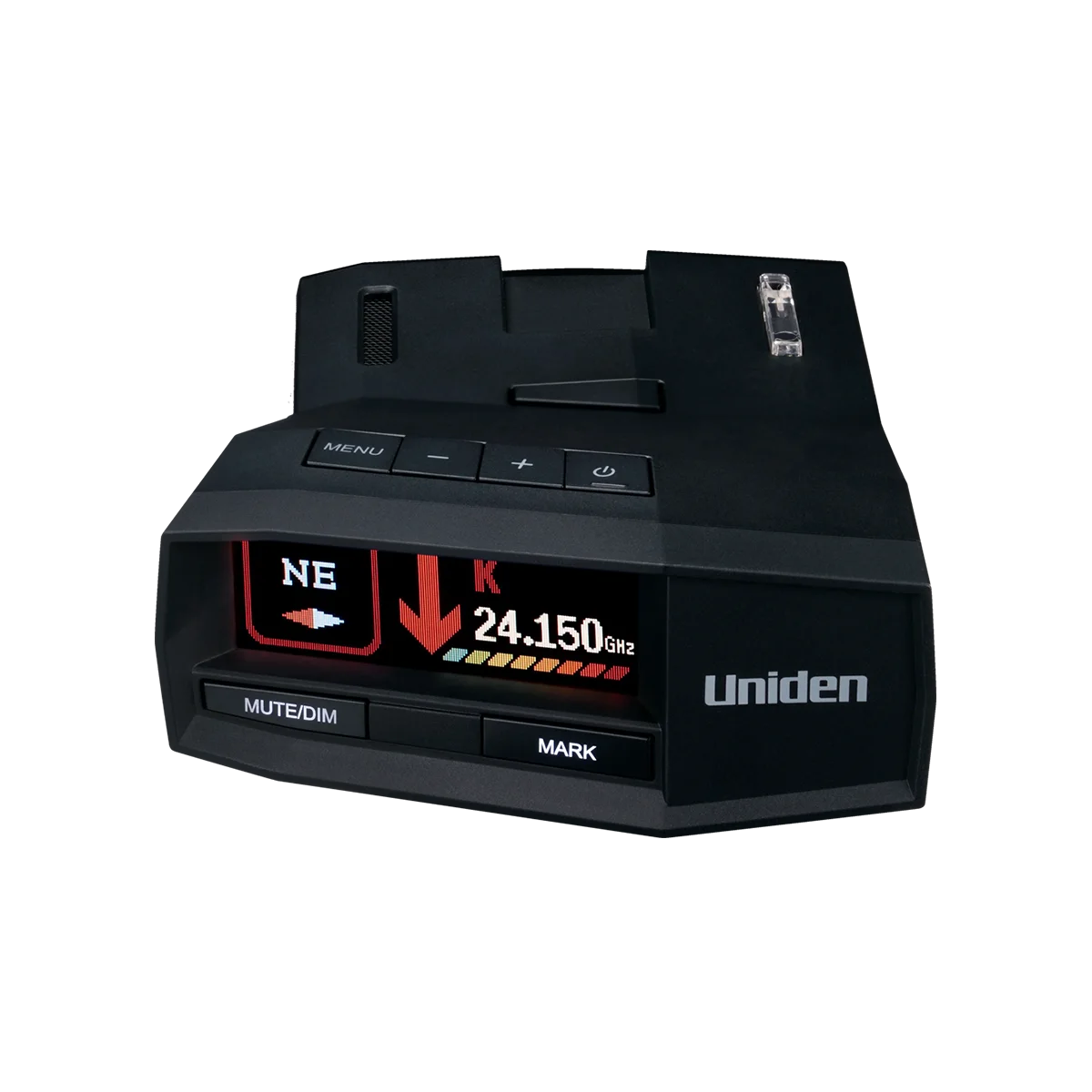 | 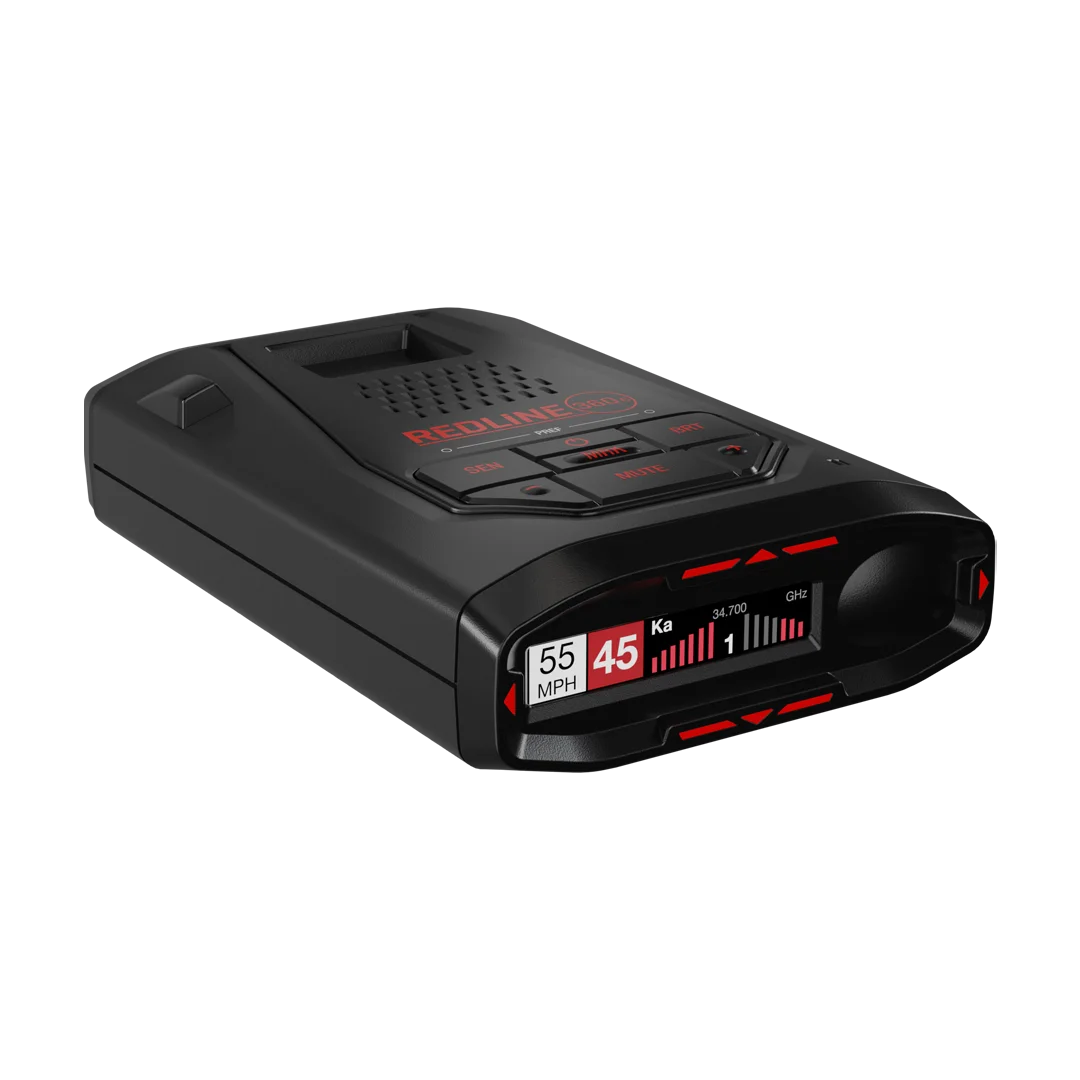 | 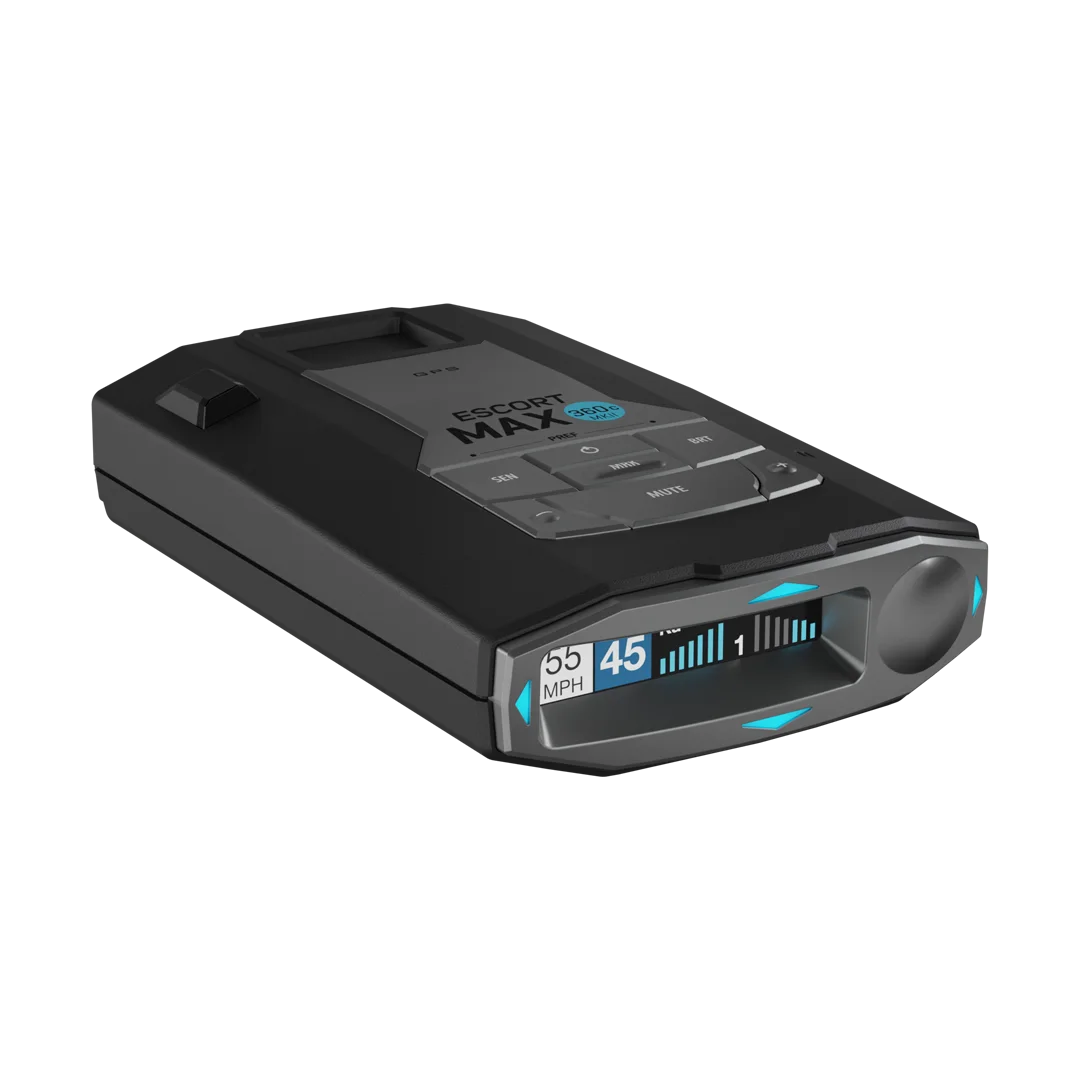 |
|---|---|---|---|
| Score | 9.4 | 9.6 | 9.0 |
| Band coverage | 4 of 4 | 4 of 4 | 4 of 4 |
| Rear antenna | 2 | 2 | 2 |
| Directional arrows | Yes | Yes | Yes |
| MultaRadar (MRCD) detection | Yes | Yes | Yes |
| GPS lockouts | auto | auto | auto |
| Ka filtering | segmentation | segmentation | segmentation |
| IVT / BSM filter | Yes | Yes | Yes |
| GPS | Yes | Yes | Yes |
| Camera database | Yes | Yes | Yes |
| RDD stealth | Yes | Yes | No |
| Phone app / connectivity | Uniden R/TACH | Escort Drive Smarter | Escort Drive Smarter |
| Laser defense | none | compatible | compatible |
| Price | $749.99 at Uniden, Nov 20 | $749.95 at Escort, Nov 20 | $509.95 at Escort, Nov 20 |
| Where to buy | Check price on Amazon | Check price on Amazon | Check price on Amazon |
Which detectors handle instant-on best?
Every detector in our top tier has the two features that matter most against instant-on: front and rear antennas and directional arrows. The differences come down to reactivity, POP support, and extras.
Documented K and Ka POP detection
Uniden R8
- Rear antenna
- 2
- Directional arrows
- Yes
- GPS lockouts
- auto
- MultaRadar (MRCD) detection
- Yes
The Uniden R8 has a Dashlore Score of 9.4 (#4 overall) with dual antennas, arrows, MultaRadar detection, Ka segmentation, optional K and Ka POP detection, a rear-balance control and Bluetooth to Uniden’s R/TACH app. Vortex Radar calls it notably fast at reacting to brief Ka and K signals even with filters on, and owners report Ka-band alerts 1.5 to 2 miles ahead on highway driving. Camera alerts need no subscription. It has no Wi-Fi, so updates run through Uniden’s R/TACH Tool on a computer. The Uniden R8w adds Wi-Fi updates and optional laser transponder support on the same detection platform, scoring 9.6 (tied #2 overall); our Uniden R8 vs R8w comparison covers the differences.
Triple-antenna layout (two front, one rear)
Escort Redline 360c
- Rear antenna
- 2
- Directional arrows
- Yes
- GPS lockouts
- auto
- MultaRadar (MRCD) detection
- Yes
The Escort Redline 360c scores 9.6 (tied #2 overall) and gets the nod for its triple-antenna layout — two front, one rear — with TotalShield stealth that multiple reviewers confirm is undetectable by all current RDDs. TechGearLab awarded it a perfect 10/10 range score. Its Ka response time needs segmentation to shine (0.21 seconds segmented vs. 0.46 seconds wide, per RDForum), so configure that before relying on it against instant-on. It launched at $749.95, and the Defender camera database is a paid subscription. Our Escort Redline 360c vs Uniden R8 comparison goes deeper. If you don’t need stealth, the Escort MAX 360c MKII has the same directional arrows and scores 9.0 — but be aware of its measured K-band reactivity lag.
See the full field in our radar detector rankings.
Frequently asked questions
What is instant-on radar?
It's police radar that stays in standby until the officer pulls the trigger on a specific vehicle. Because it isn't transmitting constantly, a detector gets no early warning from a distance.
Can a radar detector detect instant-on radar?
Only when the officer uses it on another vehicle within range of your detector. If you're the target, the gun has your speed in about the same moment your detector alerts.
What is POP radar?
POP is a mode on some MPH Industries radar guns that sends very short bursts. Uniden's R8 manual describes them as too fast for some detectors to catch, and the R8 has optional K and Ka POP detection.
Does a rear antenna help with instant-on?
Yes. Radar used on traffic behind you can reach a rear antenna before you're in the officer's sights, and directional arrows tell you whether the threat is ahead or behind.
Is instant-on the same as RF hold?
Yes. RF hold is the technical name for the standby mode in police radar guns. The gun is powered on but not transmitting until the officer pulls the trigger, which is exactly what drivers call instant-on.
Related reading
GuideRadar Detectors
Can Police Detect Radar Detectors? RDDs Explained
Can police detect radar detectors? Yes, with RDDs like Spectre and VG-2. Here's how they work, where police use them and which detectors claim stealth.
DataRadar Detectors
Radar Detector Laws in California: Mounting Rules Explained
Radar detectors are legal in California cars, but Vehicle Code 26708 limits what goes on the windshield and jammers are banned. Here's where to mount one.
Best ofRadar Detectors
Best Radar Detectors: Every Model We Track, Ranked
The best radar detectors ranked by antennas, arrows, GPS lockouts and stealth, with independent tester measurements and state-by-state legality.
VersusRadar Detectors
Escort MAX 360c MKII vs Uniden R8: Which Detector Wins?
Escort MAX 360c MKII vs Uniden R8 compared on range, filtering, RDD stealth, Wi-Fi, laser shifters and subscriptions, with tester measurements.