How to Mount a Radar Detector: Best Windshield Position
How to mount a radar detector: the best windshield spot for radar and laser, mirror vs suction mounts, state windshield rules and fixes for missed alerts.
Disclosure: Dashlore earns a commission on purchases made through some links on this page, at no added cost to you. Scores come from the spec rubric, never from commission rates. Details
On this page
Key takeaways
- Mount the detector high and centred on the windshield, level with the road, with a clear view forward and, for dual-antenna models, out the rear window.
- Keep it inside the wiper sweep and clear of the tint band, any metallic coating or heated glass, which can weaken radar and block the laser sensor.
- Several states limit what can sit on the windshield: California and Arizona allow only a 7-inch lower passenger-side or 5-inch lower driver-side square, and Minnesota and Florida don't list detectors among permitted items.
- If alerts seem late, check the angle first, then the settings: Escort ships the MAX 360c MKII with MultaRadar detection switched off.
Mount the detector high and centred on the windshield, just below the dark tint band near the rear-view mirror, with the unit level to the road. That position gives the radar antenna and laser sensor the clearest forward view. Dual-antenna models like the Uniden R8 need an unobstructed rear window too, so check behind the headrests.
A detector aimed at the sky, tucked behind coated glass or sitting low behind the wipers warns later than its hardware allows. Here’s how to get placement right, stay within your state’s windshield rules, and troubleshoot late alerts. If you’re still choosing a detector, start with our radar detector rankings.
What do you need?
- The detector and its mount. Suction-cup windshield mounts come in the box with most models. Check the mount for an angle adjustment before you start.
- Glass cleaner and a lint-free cloth. Suction cups fail on dusty or greasy glass, especially in summer heat.
- A route for the power cord. Tuck it into the headliner and down the A-pillar trim, the same way you’d route a dash cam cable.
- Optional: a mirror-stem mount. Brackets that clamp to the rear-view mirror stem keep the detector off the glass entirely. More on these below.
Step-by-step windshield mounting
- Pick the height. Aim for the upper third of the windshield, just below the dark tint band (the “frit” or sun strip) and close to the mirror. Higher means a longer, less obstructed view of the road ahead. The Uniden R8 is taller than its predecessor because the mute button moved to the front face; Vortex Radar warns that owners upgrading with an existing high mount may find the top buttons pressing against the headliner and need to lower the bracket slightly.
- Centre it, or offset slightly to the passenger side. Centred gives the antenna a symmetrical view of both lanes. A slight passenger-side offset keeps it out of your sightline.
- Check the view forward. Sit in the driver’s seat and look at the detector from the road’s perspective. Nothing — mirror housing, toll transponder, dash cam — should sit in front of its lens or laser sensor.
- Check the view back. On dual-antenna detectors such as the Uniden R8 and Escort MAX 360c MKII, the rear antenna looks out through the rear window. Headrests, cargo and rear-window shades all shorten rear warning — often your only notice of instant-on radar from traffic you’ve already passed.
- Stay inside the wiper sweep. The laser sensor needs clean glass. In rain or road spray, a detector above the wipers’ reach may miss laser entirely.
- Level it. Most windshields are raked at 25–35 degrees. Adjust the mount so the detector’s face points straight down the road, parallel to the ground. A unit tilted up even 10–15 degrees is listening to the sky, not the highway.
- Press the suction cups onto clean glass, then tug gently. If it slides, clean again.
- Route the power cord into the headliner gap and down the A-pillar trim to the 12 V socket or a hardwired power tap, leaving slack at the detector so you can remove it.
How high on the windshield should it go?
As high as you can while staying below the tint band and inside the wiper sweep. On most cars that puts the detector a few inches below the headliner, roughly level with the mirror.
The reasoning is line of sight. Radar from a patrol car over a hill crest or around traffic reaches a high-mounted detector before a low one. Reviewers and owners consistently report Ka-band alert distances of 1.5 to 2 miles on highway with a properly mounted R8 — but a low mount behind a tall SUV hood can cut that meaningfully.
There is a laser counterargument: a lower mount puts the sensor closer to the angle of beams aimed at your plate and headlights, which is where most laser targeting lands. On balance, the radar range gained by mounting high outweighs the marginal laser-angle advantage, but if you pair the detector with a dedicated laser jammer that handles the low-angle shots, the trade-off disappears.
If your state limits windshield objects to the lower corners (see below), legal compliance beats a few hundred feet of warning.
Is a mirror mount better than suction?
For a car you drive every day, usually yes. A mirror-stem mount is rock-steady, holds the detector high and centred behind the mirror (partly hidden from outside view), and doesn’t touch the glass. The trade-off is cost — it’s an extra purchase, and you need a bracket per car. Suction cups come in the box, move between cars in seconds, but can sag in heat and tilt the unit.
Big Z Review praises the Escort MAX 360c MKII’s EZ Mag Mount for its strong magnetic connection and quick detach. Vortex Radar praises the same mount design on the MAX 360 MKII — the EZ Mag Mount is shared across Escort’s MAX MKII lineup. The magnetic mount doesn’t touch the glass, which some drivers prefer in states with windshield-attachment rules — though statutes that bar objects obstructing the driver’s view can apply to anything between you and the windshield.
Make sure any bracket doesn’t block the ADAS camera module many cars have behind the mirror for lane-keeping and automatic braking.
Is windshield mounting legal in your state?
Radar detectors are legal in passenger vehicles everywhere except Virginia and Washington, D.C., as our guide to whether radar detectors are legal explains. But many states restrict what you can attach to the windshield:
| State | Passenger vehicles | Commercial (10,001+ lbs) | Details |
|---|---|---|---|
| Arizona | legal | illegal | No state law restricts radar detectors in passenger vehicles, but A.R.S. § 28-959.01 bars objects on the windshield that obstruct the driver's view except in a 7-inch square in the lower passenger-side corner or a 5-inch square in the lower driver-side corner, and commercial vehicles over 10,000 lbs are covered by the federal ban. Source |
| California | legal | illegal | No state law restricts radar detectors in passenger vehicles, but California Vehicle Code § 26708 bars objects on the windshield except in limited areas such as a 7-inch square in the lower passenger-side corner and a 5-inch square in the lower driver-side corner, and commercial vehicles over 10,000 lbs are covered by the federal ban. Source |
| District of Columbia | illegal | illegal | 18 DCMR § 736 bans selling radar detectors in the District and using or possessing one in an automobile there, with an exemption only for U.S. Armed Forces vehicles. Source |
| Florida | legal | illegal | No state law restricts radar detectors in passenger vehicles, but Fla. Stat. § 316.2952 bars any product attached to or located on the windshield except listed items such as GPS devices and toll transponders (radar detectors are not listed), and commercial vehicles over 10,000 lbs are covered by the federal ban. Source |
| Georgia | legal | illegal | No state law restricts radar detectors in passenger vehicles; O.C.G.A. § 40-8-73 bars nontransparent material on the windshield that obstructs the view but allows a wireless telecommunications or stand-alone electronic device to be mounted there so as to minimize obstruction, and commercial vehicles over 10,000 lbs are covered by the federal ban. Source |
| Hawaii | legal | illegal | No state law restricts radar detectors in passenger vehicles, but HRS § 291-21.5 limits signs, stickers and other materials on the windshield to a 7-inch square in the lower corner farthest from the driver or a 5-inch square in the corner nearest the driver, and commercial vehicles over 10,000 lbs are covered by the federal ban. Source |
| Minnesota | legal | illegal | No state law restricts radar detectors in passenger vehicles, but Minn. Stat. § 169.71, subd. 1 bars objects suspended between the driver and windshield except listed items such as GPS units mounted near the bottom of the windshield (radar detectors are not listed), and commercial vehicles over 10,000 lbs are covered by the federal ban. Source |
| Nevada | legal | illegal | No state law restricts radar detectors in passenger vehicles, but NRS § 484D.435 bars nontransparent material on the windshield that obstructs the view except within a 6-inch square in the lower corner farthest from the driver, and commercial vehicles over 10,000 lbs are covered by the federal ban. Source |
| Ohio | legal | illegal | No state law restricts radar detectors in passenger vehicles; Ohio Rev. Code § 4513.24 bars nontransparent material on the windshield but allows electronic devices such as navigation units and cameras to be mounted there if they do not block the driver's view of signs and signals, and commercial vehicles over 10,000 lbs are covered by the federal ban. Source |
| Utah | legal | illegal | No state law restricts radar detectors in passenger vehicles, but Utah Code § 41-6a-1635 bars devices mounted so as to significantly obstruct the driver's view and limits nontransparent windshield material to the top 4 inches or a 3-by-4-inch lower-left corner area, and commercial vehicles over 10,000 lbs are covered by the federal ban. Source |
| Virginia | illegal | illegal | Va. Code § 46.2-1079 prohibits operating a vehicle equipped with, using, or selling any device that detects or interferes with police radar or laser speed measurement, except a device with no power source that is not readily accessible to the driver or passengers. Source |
The states that affect mounting most: California, Arizona and Hawaii limit windshield objects to a 7-inch square in the lower passenger-side corner or a 5-inch square in the lower driver-side corner — a detector fits, but not high on the glass. Our California radar detector laws guide reads § 26708 zone by zone. Minnesota and Florida list permitted windshield items but don’t include detectors, so a dash or mirror mount is the cautious choice. Virginia and Washington, D.C. ban the detector itself.
Look up every state on your route with our radar detector laws by state tool. Commercial vehicles over 10,000 lbs can’t carry a detector anywhere in the US — our commercial vehicle radar detector laws guide explains the federal rule. Our dash cam windshield law data covers the same statutes from the camera side.
Why is the detector missing alerts?
If warnings feel late or expected alerts never arrive, work through this list in order.
- Angle. Re-level the detector. Heat makes suction cups creep, and a drooping unit points at the dashboard instead of the road.
- Obstruction. Check for a toll tag, dash cam, mirror housing or coated glass in front of the lens.
- Rear view. On dual-antenna models, check that cargo or a rear shade isn’t blocking the rear antenna. The R8 has a rear-balance setting that reduces rear sensitivity; the R8 owner’s manual describes it. Make sure it isn’t turned down further than you meant.
- MultaRadar detection. Escort ships the MAX 360c MKII with MultaRadar CD/CT detection switched off by default, per its owner’s manual. If you drive where photo radar is common, turn it on. We explain the threat in what is MultaRadar? and list models that detect it in our photo radar detector picks.
- Ka segmentation. Both detectors can narrow Ka to the frequencies police use, cutting false alerts but also silencing anything outside those segments. Our guide to Ka band segmentation covers which segments matter in your area, and radar detector bands explained gives the broader picture.
- Lockouts. GPS lockouts silence stationary false sources. A lockout set on a road with a regular speed trap will mute it too. The R8 stores up to 1,750 lockouts; Vortex Radar, Automoblog and RDForum owners all flag auto lockouts as the R8’s main weakness, noting they sometimes fail to mute known false locations or take too long to activate. Some owners work around the issue with manual lockouts or the third-party R8 Companion app. Our guide to reducing radar detector false alerts explains how lockouts and filters decide what you hear.
- K-band filtering and reactivity. Vortex Radar measured a 2-to-4-second delay on K-band instant-on with the MAX 360c MKII on launch-era firmware (his October 2022 review, shortly after the September 2022 release), depending on the radar gun. Firmware updates have improved this, but check that you’re running the latest version — the MKII’s dual-band Wi-Fi is supposed to handle that automatically, though some owners report flaky 5 GHz connections. City and auto modes also reduce K-band sensitivity at low speed intentionally.
Dual-antenna detectors reward good placement most
Any detector mounts the same way, but dual-antenna units benefit most from careful placement because a clear rear view is half their advantage. Both the R8 and MAX 360c MKII have front and rear antennas with directional arrows that tell you whether a signal is ahead, beside or behind.
| Spec | 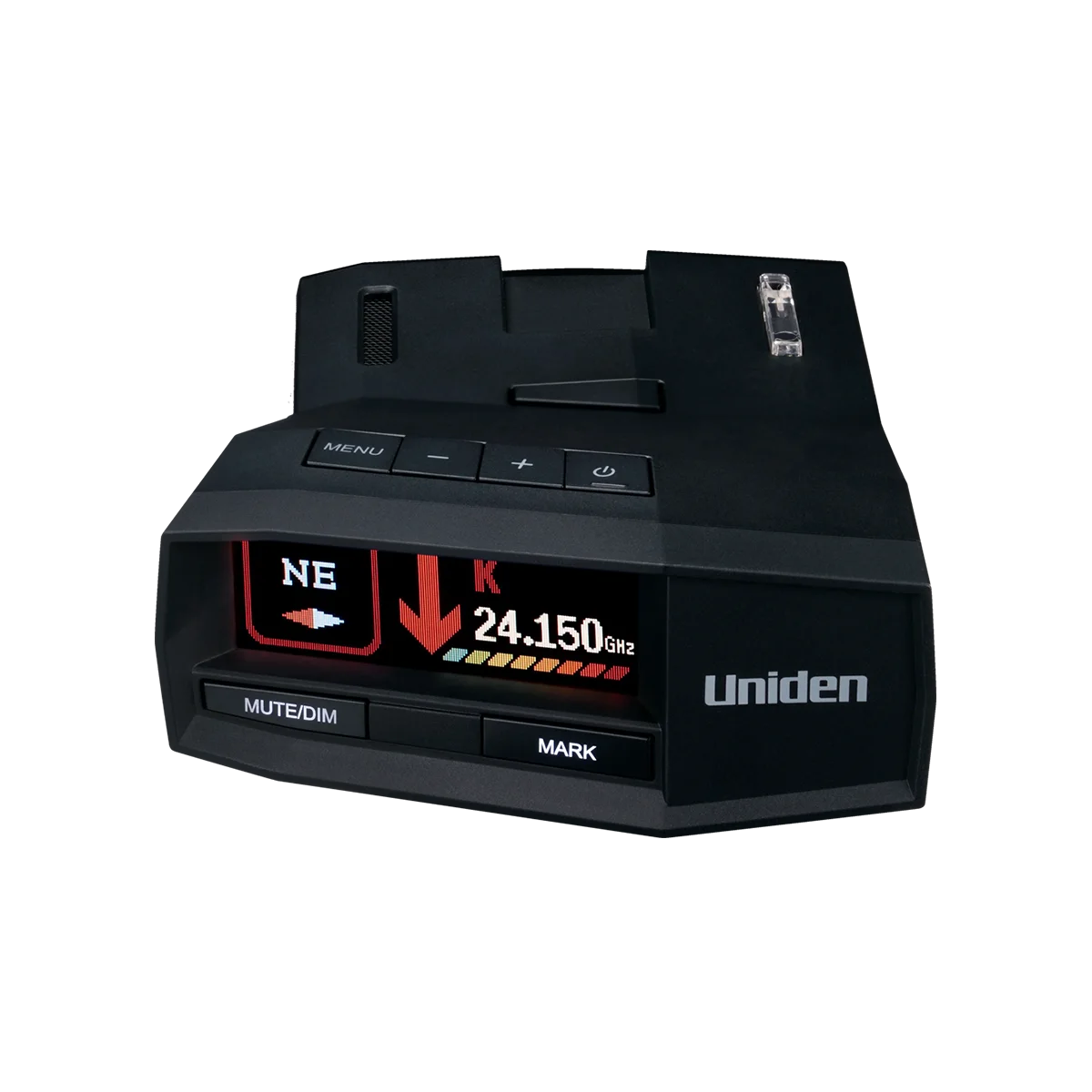 | 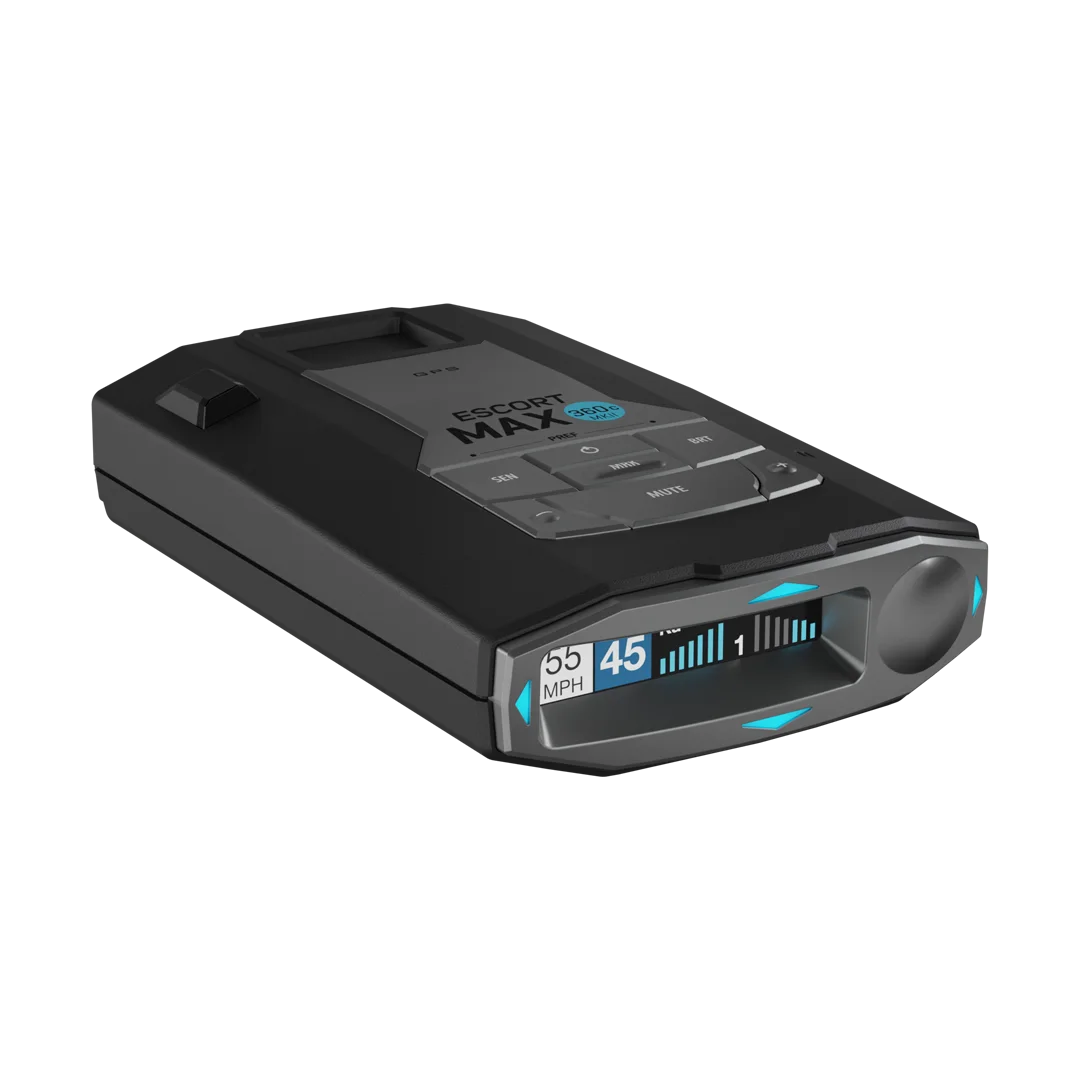 |
|---|---|---|
| Score | 9.4 | 9.0 |
| Band coverage | 4 of 4 | 4 of 4 |
| Rear antenna | 2 | 2 |
| Directional arrows | Yes | Yes |
| MultaRadar (MRCD) detection | Yes | Yes |
| GPS lockouts | auto | auto |
| Ka filtering | segmentation | segmentation |
| IVT / BSM filter | Yes | Yes |
| GPS | Yes | Yes |
| Camera database | Yes | Yes |
| RDD stealth | Yes | No |
| Phone app / connectivity | Uniden R/TACH | Escort Drive Smarter |
| Laser defense | none | compatible |
| Price | $749.99 at Uniden, Nov 20 | $509.95 at Escort, Nov 20 |
| Where to buy | Check price on Amazon | Check price on Amazon |
Dual antennas with RDD stealth and 1,750 GPS lockouts
Uniden R8
- Rear antenna
- 2
- Directional arrows
- Yes
- GPS lockouts
- auto
- MultaRadar (MRCD) detection
- Yes
Dual antennas with Wi-Fi updates and EZ Mag Mount
Escort MAX 360c MKII
- Rear antenna
- 2
- Directional arrows
- Yes
- GPS lockouts
- auto
- MultaRadar (MRCD) detection
- Yes
The R8 has a Dashlore Score of 9.4 (#4 overall) and the MAX 360c MKII 9.0 (tied for #6). The R8’s owner’s manual carries a Spectre I/IV stealth claim, though TechGearLab notes it is not fully invisible to all RDD units — a distinction that matters if you drive where police can detect radar detectors. The MAX 360c MKII adds Wi-Fi firmware updates and compatibility with Escort’s optional ZR5/ZW5 laser shifters. Vortex Radar’s month-long test of the MKII logged only four blind-spot false alerts total — with K Notch (an extra K-band filter) turned off — making it one of the quietest daily drivers available, a real advantage in city commuting where filtering matters more than range.
If you’re deciding whether a detector earns its windshield space, read are radar detectors worth it?. For a head-to-head, see our Escort MAX 360c MKII vs Uniden R8 comparison, or browse the best radar detectors at every price.
Frequently asked questions
Where is the best place to mount a radar detector?
High and centred on the windshield, just below the tint band and near the rear-view mirror, with the unit level to the road. That gives the radar antenna and laser sensor the longest clear view over the hood.
Can I put a radar detector on the dashboard?
You can, and in states that restrict windshield objects it may be the safer legal choice. Expect shorter warning because the hood blocks part of the view and the laser sensor sits lower.
Do radar detectors work behind tinted or coated windshields?
Clear glass and ordinary tint are fine. Metallic infrared-reflective coatings and heated windshields like Ford's InstaClear can weaken radar, so cars that have them usually leave an uncoated patch near the mirror; mount the detector there.
Is a mirror mount better than a suction cup?
A mirror-stem mount holds the detector steady, keeps it off the glass and hides it behind the mirror. Suction mounts are cheaper and easier to move between cars but can sag in heat and tilt the unit.
Should a radar detector be level or angled?
Level, parallel to the road. Most windshields are steeply raked, so adjust the mount until the detector's face points straight ahead rather than up at the sky.
Will mounting a radar detector block my ADAS camera?
It can. Many cars have a lane-keeping or automatic braking camera behind the rear-view mirror. Mount the detector beside the mirror housing, not in front of the camera module, or those driver-assist features may stop working.
Related reading
GuideRadar Detectors
Can Police Detect Radar Detectors? RDDs Explained
Can police detect radar detectors? Yes, with RDDs like Spectre and VG-2. Here's how they work, where police use them and which detectors claim stealth.
GuideRadar Detectors
Radar Detector Bands Explained: X, K, Ka and Laser
Radar detector bands explained: X, K, Ka and laser frequencies, plus VG-2 — what transmits on each, which alerts are real and which bands to turn off.
DataRadar Detectors
Radar Detector Laws in California: Mounting Rules Explained
Radar detectors are legal in California cars, but Vehicle Code 26708 limits what goes on the windshield and jammers are banned. Here's where to mount one.
GuideRadar Detectors
What Is Instant-On Radar and Can Detectors Catch It?
Instant-on radar stays silent until an officer targets a car, so your detector only warns you when someone else gets clocked first. Here's how to respond.